Stainless Restoration Ltd
All coating applications are monitored on site and many tests are performed which are necessary to ensure the long term performance of the coating. This includes on site monitoring of climatic conditions, surface preparation, application of the coatings, wet film and dry film measurement.
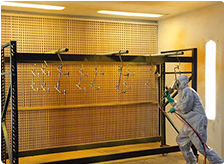
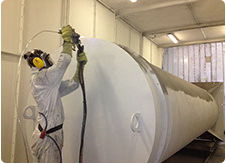
We have fully enclosed facilities for both shot blasting and coating to a size of 15m long x 5.5m wide x 5m high. All coatings are applied in a stand alone, fully enclosed booths. All Booths implement a heating mechanism thus allowing the correct climatic conditions to be present before, during and after the coating process. This is essential in order to produce high quality, reliable coatings.
Applications:
Structures/Products for marine environments
Steel Structures
Offshore
Pipelines
Services we offer:
Specification development
Coating system selection
Specification review
Technical support
NACE qualified inspectors
Our primary focus is on the application of protective coating systems that provide excellent corrosion control at the best value.
These high quality, cost effective surface preparation and protective coating systems are applied at our extensive 75,000 square foot processing and storage facility, with handling capacity up to 30 tonnes, in east Manchester.
In order to achieve a quality, reliable and long lasting coating, Surface Engineers follow good coating practices in line with recognised national and international standards. In short, the surface is prepared by abrasive blasting to create a surface profile which acts as an anchor for the coating. Surface preparation is to a coating system what a foundation is to a building. If a coating system has a poor foundation (Surface preparation) it will fail sooner than expected which can lead to great financial losses. Furthermore, any moisture on the surface will cause the coating to fail and therefore climatic conditions are measured prior to coating to prevent any failures. Single or multi coat systems are applied in line with customer or paint manufacturer's specifications. The wet film coating thickness is then measured, to check that it will cure to the specified dry film thickness. Finally, the dry film thickness is measured to ensure it complies with the specification.
Surface preparation is the essential first stage treatment of a substrate before the application of any coating. The performance of a coating is significantly influenced by its ability to adhere properly to the substrate material. It is generally well established that correct surface preparation is the most important factor affecting the total success of surface treatment. It affects the performance of the coating more than any other variable.
Surface preparation creates a foundation for the coating mechanically and chemically:
Mechanically: By providing an anchor/key for the coating
Chemically: By allowing intimate contact of coating material molecules with the steel (or other material) surface
Steel, when it is abrasive blasted, has a surface that is rough, with a series of tiny peaks and valleys called surface profile. Coatings anchor to the valleys of the profile and the peaks are like teeth. This is why the surface profile, created by blasting is called an "Anchor pattern" or a "Mechanical tooth".
The surface is blasted to standard grades of cleanliness in accordance with ISO 8501-1 1988 (BS 7079 Part A1 1989). This standard essentially refers to the surface appearance of the steel after abrasive blast cleaning and gives descriptions with pictorial references of the grades of cleanliness. Generally, Class Sa 2.5 is the most common:
Sa 1: Light blast cleaning
Sa 2: Thorough blast cleaning
Sa 2.5: Very thorough blast cleaning
Sa 3: Blast cleaning to visually clean standard
Optimal environmental conditions are essential for surface preparation, application, and curing of coatings to maximise successful performance.Surface preparation and the application of coatings should be performed under optimum environmental conditions to help prevent failures. The following conditions should be observed:
Air temperature
Surface temperature
Relative humidity (RH)
Dew point temperature
Delta T: The difference between the surface and dew point temperatures
It is commonly known that most coatings will not dry properly at low temperatures and high RH. Surface moisture has a significant impact on the life and performance of the coating.Moisture forms on a surface when warmer, moist air comes into contact with it (condensation). Moisture will cause unprotected steel to rust. If it is trapped between a coating and a substrate, moisture will likely cause the applied system to fail prematurely.Instruments are used to help assess the risk of moisture forming on the surface. Tests are performed to calculate the dew-point temperature before, during and after the coating process. Dew-point temperature is compared to the surface temperature to ensure the two are far enough apart that moisture formation is unlikely.Careful observation of atmospheric conditions and a good understanding of their impact on the quality and long term health of coating are essential.
Metal or thermal spraying is a technology, which protects and greatly extends the life of a wide variety of products in the most hostile environments and in situations where coatings are vital for longevity. The variety of metallised coatings is vast but can be broken down into two main categories. These include finishing coatings, such as anti-corrosion or decorative coatings, and engineering coatings such as wear resistant and thermal barrier coatings.
Metal spraying is carried out in a wide range of anti corrosion and engineering markets, including oil and gas, construction, petrochemical and marine. Corrosion is a major problem for these industries. There are four commonly used processes in thermal spraying; Flamespray, Arcspray, Plasma Spray and High Velocity Oxygen Fuel (HVOF), but only two of these, Flamespray and Arcspray are normally used for finishing coatings.
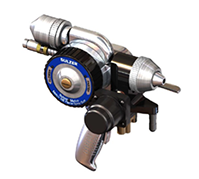
All methods of thermal spraying involve the projection of small molten particles onto a prepared surface where they adhere and form a continuous coating. To create the molten particles, a heat source, a spray material and an atomisation/projection method are required. Upon contact, the particles flatten onto the surface, freeze and mechanically bond, firstly onto the roughened substrate and then onto each other as the coating thickness is increased.
As the heat energy in the molten particles is small relative to the size of the sprayed component, the process imparts very little heat to the substrate. As the temperature increase of the coated parts is minimal, heat distortion is not normally experienced. This is a major advantage over hot-dipped galvanising.
In the Arcspray process, two electrically charged wires are driven and guided so that they converge at a point and form an arc. An air nozzle atomises the molten metal produced and projects it towards the work piece. The driving of the wires is typically either by air motor or electric motor and gearbox arrangement. The wires can be driven in three different ways, all which offer individual benefits.
Push only, where the wire is pushed from a drive unit to the pistol. Pull only, where the wire is pulled by a drive unit mounted in the pistol. Push/Pull, this method is obviously a combination of these two methods, where the wire is driven to and pulled from the pistol. Wire can typically be dispensed from portable MIG reels, coils or production packs (drums) depending on the application requirements.
This sounds like it should be an easily answered question, but, as with many engineering situations, a clear and precise answer is not available. In some instances, the coating properties achievable by one or the other processes does provide a simple answer. For example, arc sprayed aluminium has a bond strength that is approximately 2.5 times higher than flame sprayed aluminium. Other factors include deposit efficiency, ease of operation, safety/spray environment, changeover time, maintenance time and costs, coating finish and ease of automation.The above considerations give an insight into the wide range of variables when choosing which process to use. It is worth mentioning that a matter of personal or local market preference can also be added into the decision matrix.
Thermal Spraying is not a new process. It has proved itself to be extremely effective in the 90 years of its existence in all manner of applications ranging from coatings in gas turbines to corrosion protection on park benches. As a protective system for structural steelwork it is unsurpassed being the only system, recommended by International and European standards EN ISO 14713 as giving greater than 20 years to first maintenance in very aggressive environments such the marine splash zone (category lm2) as well as all other categories.

With over 42 years in the preparation and application of wet paint systems we have experience in the processes and techniques of a wide range of paint products and their specific applications. Wet paint systems are employed for both anti corrosion protection and for cosmetic finish purposes from single coat primer applications to multi-coat two-pack systems. Hi-build two-pack system will offer long life corrosion protection in excess of 20 years in the harshest of environments.
We draw from an extensive range of paint manufactures producing polyurethane and epoxy systems that can provide protection in temperatures from -30°C up to 400°C from splash zone and immersed or sub-sea conditions to desert and aggressive industrial environments.
The NORSOK standard gives the requirements for the selection of coating materials, surface preparation, application procedures and inspection for protective coatings to be applied during the construction and installation of offshore installations and associated facilities. The standard covers paints, metallic coatings and application of spray-on passive fire protective coatings.
The aim of the NORSOK standard is to obtain a coating system, which ensures.
Our applicators are trained to the requirements of the Norsok M501 standard on various systems and have passed rigorous practical and theoretical testing to ensure specification compliance. Records are available for our operators and Inspectors giving the customer the confidence that the contract is dealt with by professionals and in a professional manner.
We have approvals for many major projects around the world and are the preferred suppliers to a number of OEMS in the UK.
We would be more than happy to discuss Project specific requirements.
Epoxy and polyester powder coatings baked on to prepared metalwork to provide a hard wearing decorative finish.
We offer effective coatings solutions for a wide range of applications, including furniture, automotive, IT, appliance, the architectural market and general industry.
Range of colours available from stock.
Powder coatings are used when a hard finish which is tougher than conventional paint is required. Basically anything capable of holding a small electrical charge can have powder applied to it. It is usually used for coating metals, however, newer technologies allow other materials such as MDF and even glass and ceramics to be coated using different coating methods.
Powder application is very simple. The powder is applied to an object using an electrostatic gun. Compressed air pushes the powder out of the gun, past an electrode which gives the powder a positive charge. The object being coated is grounded so the positive powder particles are attracted to it. When the object is completely covered, the ground is removed and the object is put into the oven to be baked. While in the oven, the powder goes through a chemical change where it becomes free flowing and forms a ‘skin’ around the object. After cooling, the powder is ‘set’ and forms a hard finish.
Powder can be applied to items kept inside; including washing machines and lighting and also to exterior items including architecture and fencing. Powders are capable of withstanding extreme environments, thanks to our intensive testing procedures. The levels of powder durability are dependant on the mix of ingredients used.